
What Is RTP In Real Money Slots? Meaning, Examples & Payouts
A slot can display 96% RTP and still return nothing during a short session. That apparent contradiction is why understanding what is RTP in real money slots matters. RTP, or Return to Player, is the theoretical share of total wagers a game is designed to pay back over an enormous sample, not a refund attached to one $100 deposit. It is based on turnover, so winnings that are wagered again also count toward the calculation.
In practice, what does RTP mean in slots? It reveals the game’s long-term mathematical cost, but it does not show when wins will arrive or how large one result may be. House edge, variance, volatility, hit frequency, active RTP versions, jackpot contributions, and bonus conditions complete the picture. Used correctly, these measures allow players to compare slot mathematics without turning a statistical average into a prediction.



What RTP Means In Real-Money Slot Play?
RTP is the percentage of total stakes a slot is designed to return over extended play. It includes outcomes, prizes, features, and jackpots in the active version. A 96% RTP corresponds to a 4% house edge. Over extensive wagering, the game is expected to return about $96 per $100 staked and retain about $4. This is not a personal repayment schedule.
RTP applies to turnover rather than deposits. A $100 deposit can generate $500 in total stakes when smaller wins are wagered again, so the theoretical comparison uses $500.
What A 96% RTP Really Represents?
A 96% figure is a long-run average across losing spins, smaller payouts, features, and rare larger prizes. A short session may return nothing or more than the amount wagered.
The game does not reserve $4 from each $100 and return $96 in sequence. Random outcomes are uneven, so RTP becomes more representative as the sample grows.
Higher RTP generally means lower mathematical cost at equal turnover, not lower short-term risk. Stake size, volatility, session length, and random variation can still produce very different results.
Repeated wagering can make turnover much larger than the starting balance during a long or highly active session overall. For example, a $100 balance recycled through several rounds may create hundreds of dollars in total stakes. RTP applies to that accumulated amount, which is why deposit size alone cannot be used to estimate an expected return.
More Real Money Casino Resources
How Slot RTP Is Calculated?
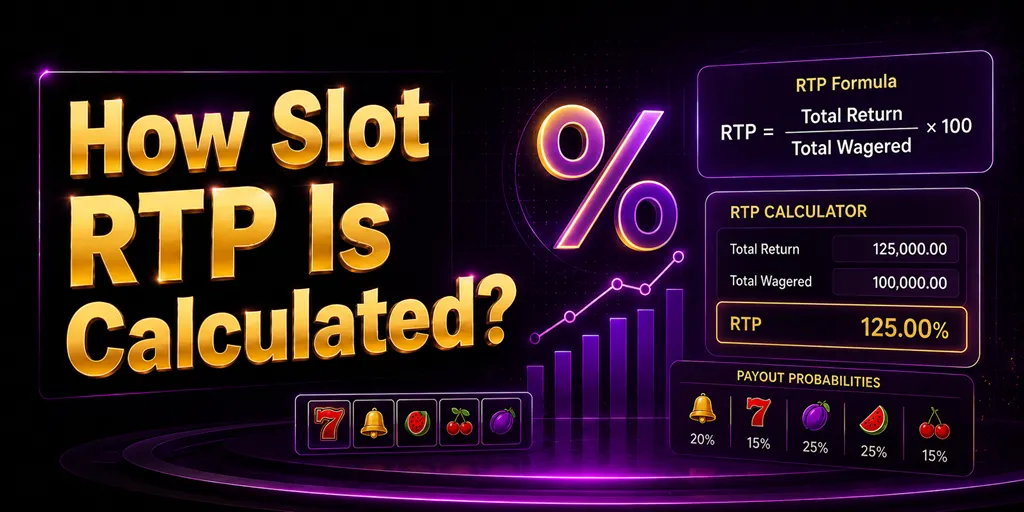
The basic formula is: RTP = Total Theoretical Payouts ÷ Total Wagers × 100
How to calculate RTP slots begins with the relationship between prize probabilities and their assigned values. Developers assign weights to symbols and outcomes, define the paytable, and calculate the expected value of base-game wins, bonus rounds, multipliers, jackpots, and other included features.
If a model predicts $960,000 in payouts from $1,000,000 in total wagering, its RTP is 96%. The remaining $40,000 represents a 4% theoretical house edge. Recorded results over a limited period may finish above or below those figures.
Symbol weights determine how frequently each outcome can be selected, while the paytable determines its value. Multiplying each prize by its probability and adding the results creates the expected return per unit wagered. Features are included according to their trigger probability and average payout, rather than being treated as guaranteed value.
Mathematical Analysis And Game Simulation
Some models can be evaluated across every possible combination. Complex games may also use simulations to test whether repeated results align with the designed return.
Analysis can include reel strips, symbol weights, paytables, bonus triggers, multipliers, jackpots, and optional modes. The complete game matters because base play and features may contribute different portions of the total RTP.
Certified RTP And Field Data
Before regulated release, independent testing can examine mathematical files, paytables, RNG behavior, and compliance with the approved model.
Recorded field data may later be compared with the theoretical figure using wagering volume, volatility, statistical tolerance, and repeated reporting periods. A single small deviation carries less weight than continued inconsistency across a growing sample.
Testing can also confirm that displayed rules match the approved mathematical model and that the random number generator produces outcomes within technical standards. This process does not make individual sessions predictable. It verifies that the software follows the probabilities and payout logic described in its certified configuration.
RTP And House Edge
The relationship is straightforward: House Edge = 100% – RTP
RTP vs house edge in slots describes the same mathematical relationship from opposite perspectives. RTP estimates the portion returned to players, while house edge estimates the portion retained by the game over the long term.
A 98% RTP produces a 2% house edge. A 96% RTP produces a 4% house edge. A 94% RTP produces a 6% house edge. At equal wagering volume, the higher RTP creates a lower expected mathematical cost.
Expected Cost At Equal Turnover
With $100 in total wagers, a 2% house edge represents an expected cost of $2, while a 6% edge represents an expected cost of $6. With $1,000 in wagering, those figures become $20 and $60.
These are statistical expectations, not guaranteed losses. Short-session results may be better or worse. The figures are most useful when comparing games at equal stakes and turnover.
Theoretical Return And Actual Session Results
The distinction theoretical RTP vs actual RTP separates the mathematical model from results recorded during play. Theoretical RTP comes from probabilities and payouts. Actual RTP is calculated after play by dividing recorded winnings by recorded wagering.
A personal session can differ sharply from both theoretical and wider recorded RTP.
Why Sample Size Matters?
In session analysis, slots RTP and variance depend heavily on sample size. Hundreds or thousands of spins may still be too few to reproduce the long-run percentage closely, especially when uncommon prizes carry substantial value.
Statistical tolerance is wider in small samples and narrows as wagering grows. Volatility and standard deviation influence how quickly actual results move toward the theoretical figure. One evening cannot verify whether the stated RTP is accurate.
Why A Slot Is Never Due?
Each spin is generated independently. Losses do not make a win due, and a recent prize does not prevent another prize. Extending play to recover money increases exposure without improving the next outcome’s probability.
How RTP Works Inside An Online Slot?
RTP And RNG Are Different
Random selection and long-term mathematical design perform different roles. A random number generator selects each spin’s outcome, which is resolved through the reel structure, paytable, and feature rules.
RTP emerges from the probabilities and prize values in that structure, not from alternating wins and losses or tracking one player’s results. Each spin uses the active configuration unless the rules define another mode.
Base-game prizes may provide one portion of the return, while free-spin rounds, multipliers, collection features, and fixed jackpots contribute another.
Games with the same RTP can distribute value differently. One may concentrate return in infrequent features, while another pays more through smaller base-game wins.
A progressive jackpot can form part of the combined RTP or appear as a separate contribution. A stake or mode that cannot trigger it may not receive the full advertised return.
Feature purchases and enhanced modes may use separate prices, probabilities, or RTP figures, so their rules require independent review.
Does a bonus buy change RTP?
It can. A feature-purchase mode may use the same percentage as ordinary spins, but it can also use a higher or lower mathematical return. The purchase price, guaranteed feature entry, symbol weighting, and feature payout distribution all influence the figure.
The rules should state separate percentages when normal play and feature purchases use different models. A higher bonus-buy RTP does not necessarily mean more frequent wins because volatility may also change. The active mode determines the relevant return.
Feature purchases also change the amount committed before the round begins. A purchase priced at 100 times the base stake concentrates more money into a single event than 100 separate spins, even when both modes have similar RTP. The result can therefore feel more volatile and can consume a balance faster.
RTP, Volatility, Hit Frequency, And Maximum Win
RTP vs volatility in slots separates long-term return from payout distribution. RTP measures expected value, while volatility shows how unevenly prizes may arrive.
Low volatility generally means smaller, more frequent payouts. High volatility can mean longer gaps and larger potential wins. Medium volatility falls between them.
Two games can share a 96% RTP but feel different because one relies on modest prizes and another on rare features. Session risk can remain substantial.
RTP And Hit Frequency
RTP vs hit frequency matters because hit frequency counts payout events, not whether a payout exceeds the stake.
A $1 spin returning $0.40 can count as a hit despite a $0.60 net loss. Frequent animations can accompany a declining balance.
Higher hit frequency does not automatically mean higher RTP, and higher RTP does not guarantee more frequent wins. Prize values and probabilities must be considered together.
Maximum Win Is A Separate Metric
Maximum win describes the largest possible payout, usually as a multiple of the stake. It does not reveal how likely that outcome is or how much of the RTP depends on it.
A huge maximum win may be extremely rare, while a lower maximum can accompany higher RTP when ordinary prizes return more value.
| Metric | What It Measures | What It Does Not Measure | Practical Meaning |
| RTP | Long-term return | One session | Mathematical cost at equal turnover |
| Volatility | Payout distribution | Overall return | Pattern of prize sizes |
| Hit frequency | Payout frequency | Profit per hit | Some hits return less than the stake |
| Maximum win | Largest payout | Chance of receiving it | Potential, not expected return |
What Counts As A Competitive RTP?
Determining what is a good RTP for slots requires comparing versions offered under similar conditions. An RTP of 98% or higher is exceptionally high. Figures from 97% to 97.99% are high; 96% to 96.99% are competitive. Percentages below 96% create a greater expected cost at equal turnover.
These ranges are general comparison bands, not nationwide legal classifications. Approved games can still have different RTP figures.
How To Interpret A Higher RTP?
A higher percentage reduces long-term house edge but cannot remove volatility or short-term losses. Much of the return may depend on rare features or jackpots.
| RTP Range | House Edge | Interpretation | Limitation |
| 98% or higher | Below 2% | Exceptionally high | May remain highly volatile |
| 97% to 97.99% | 2.01% to 3% | High | Does not predict sessions |
| 96% to 96.99% | 3.01% to 4% | Competitive | Active version needs verification |
| 94% to 95.99% | 4.01% to 6% | Lower | Higher expected cost |
| Below 94% | Above 6% | Higher theoretical cost | Bonus terms may add restrictions |
RTP measures game mathematics only. Legal availability, licensing, payments, and promotional conditions require separate checks.
Why One Slot Can Have Multiple RTP Versions?
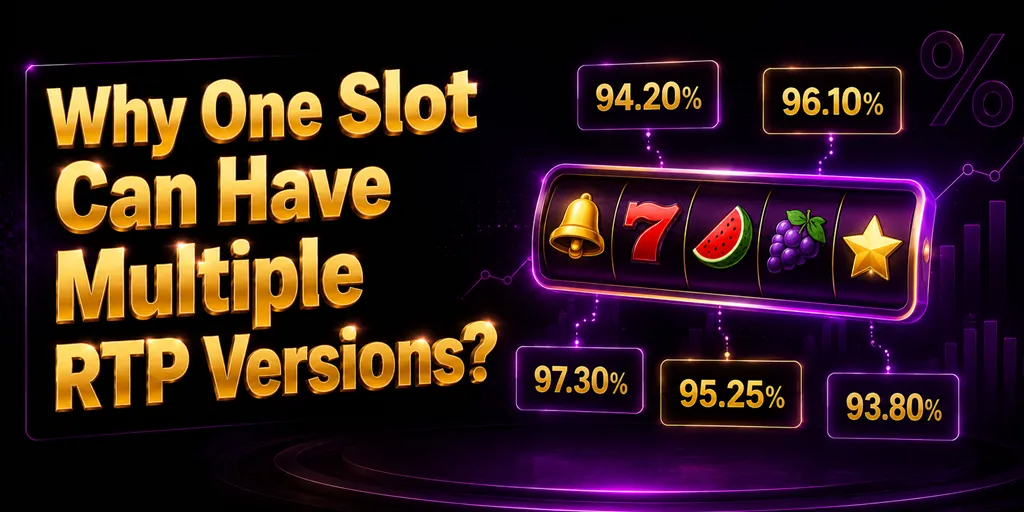
Can the same slot have different RTP? Yes. One title may be released in several approved mathematical configurations. Each version can adjust symbol weights, feature probabilities, jackpot contributions, or paytable values. A game might exist in 96%, 94%, and 92% versions while keeping the same artwork and main features. The active configuration is selected before play.
Does Bet Size Affect The Active RTP?
Does bet size affect slot RTP? Changing a standard stake does not automatically alter the percentage. Many games use one return across ordinary bet levels, although certain stakes may change jackpot eligibility, features, or prize structures.
Check the paytable instead of assuming that minimum or maximum bets improve RTP. Even when the percentage stays constant, a larger stake increases the money exposed on each spin.
Configuration Changes And Real-Time Manipulation
Multiple versions should not be confused with changing RTP in response to individual results. A regulated configuration follows its approved mathematical file, and permitted changes use controlled deployment procedures rather than invisible adjustments after each spin.
Why The Active Version Matters?
A review, database, or older page may show another configuration. The most relevant figure is the RTP displayed for the active version. Conflicting figures can reflect separate approved settings, while missing or unclear information limits reliable comparison.
How To Find And Verify The Active RTP?
To understand how to check RTP on slots, begin inside the game rather than with an external summary.
Look inside the game for its information, rules, help, or paytable menu — usually an “i”, “?”, or three-line icon near the game controls.
Scan that menu for “Return to Player,” “RTP,” “Theoretical Return,” or “Payback.” These all refer to the same underlying figure.
See whether optional features or jackpot contributions are listed with their own separate percentages, since these can differ from the base game figure.
Confirm the figure shown applies to the active game mode and stake setting you’re actually using — some games list different rates per bet level.
Record the percentage and date whenever you’re comparing different game versions, since studios sometimes update RTP across releases.
Comparing Technical Information
Technical documentation may provide a range of approved configurations. Independent testing records can also confirm which mathematical versions have been evaluated.
Which RTP Source Should Be Trusted?
Use the percentage displayed in the active game rules first. Provider documents and regulatory records can confirm available configurations. Review pages and databases help with discovery but may show a default, older, or foreign-market version.
Record the mode, percentage, jurisdiction, and date checked so later comparisons remain accurate.
Screenshots or saved notes are useful when the game later receives an update. They show which percentage was visible at the time of comparison and prevent an older figure from being confused with a newer configuration. The source should identify the exact mode instead of presenting one number as universal.
When The Percentage Is Missing?
A missing RTP should not be estimated from appearance, reputation, or short-term results. A broad range can show available configurations, but it does not identify the exact version active for play.
RTP In The United States
Online and land-based slot information mainly differ in how percentages are presented. Online games may display RTP in a help screen, paytable, or rules page. Physical machines may place information in a menu, machine documentation, or regulatory filing.
Disclosure practices vary. Some physical machines show limited player-facing information, while approved technical records contain more detail. Online presentation can make the percentage easier to locate when the active figure is stated.
Neither format guarantees that a player will experience the published return during a short session. The mathematical interpretation remains the same.
State-Specific Regulation
RTP oversight in the United States operates through state systems rather than one national minimum. Technical standards, testing procedures, legal availability, and payout requirements depend on the state and the form of gambling involved.
Some states set minimum theoretical return requirements for machine categories. Those minimums should not be treated as market averages or federal rules. A compliant game may still have a lower RTP than another compliant game.
A state minimum is a compliance floor, not a typical return or recommendation. A machine can meet the applicable rule while offering a lower percentage than another approved machine. Comparisons should therefore use the displayed game figure rather than assuming all legal games share the same return.
RTP cannot establish whether online real-money slot play is legal in a player’s location. Legal access, age requirements, identity checks, and licensing must be assessed separately under the state framework.
RTP In Free Spins And Bonus Play
Does RTP apply to free spins? The answer depends on which type of free spins is involved. Free-spin features triggered inside a game are normally included in its mathematical RTP. Promotional spins awarded separately use the active game mechanics, but their practical value also depends on the attached conditions.
Suppose a promotion provides 20 spins at $0.20 each. The initial wagering value is $4. On a game with 96% RTP, $3.84 is the theoretical long-run return from $4 in wagering. That does not guarantee $3.84 in withdrawable winnings. The result may be zero, lower, or higher.
Wagering Conditions And Practical Value
The relationship between RTP and wagering requirements matters when winnings must be played through before withdrawal. A high RTP does not cancel the mathematical effect of repeated wagering.
Terms may restrict eligible games, assign different contribution percentages, limit the maximum stake, set an expiration period, or cap withdrawals. A game with favorable RTP may contribute little or nothing toward the requirement.
For example, $20 in bonus winnings subject to a 20-times condition may require $400 in qualifying wagers. Expected cost depends partly on eligible-game RTP, but volatility can exhaust the balance before completion.
How RTP Fits Into Bonus Value?
Bonus value depends on spin value, eligible play, expiry, cashout rules, and feature restrictions as well as RTP. Identity verification, payment methods, location requirements, and account conditions may also affect how winnings can be used or withdraw.
Common RTP Myths
A Slot Must Pay After A Losing Streak
A losing sequence does not make a win due. Continuing to recover losses only increases total wagering exposure.
A Recent Large Win Prevents Another Win
A jackpot does not reduce the chance of another valid outcome. Previous spins do not change the next spin’s probability.
Increasing The Stake Always Improves RTP
Some games use one RTP at every stake, while others change jackpot eligibility or feature access. Check the paytable before assuming a larger bet improves the return.
Demo Results Prove Real-Money Performance
A demo session cannot verify RTP because random variation can produce strong or weak results. Check whether demo and real-money versions use matching rules and configurations.
High RTP Means Low Risk
High RTP means a lower long-run house edge at equal turnover, not low short-term risk. A high-volatility game with strong RTP may still produce losing sequences and rapid balance changes.
Why RTP Matters When Comparing Slots?
RTP supports consistent comparison when stake, turnover, and game version are held equal. It works best alongside volatility, hit frequency, feature rules, and jackpot eligibility rather than as a forecast.
Two percentages should be compared only when the surrounding conditions are similar overall. A 97% version with a highly concentrated jackpot contribution may create a different session pattern from a 96% version that returns more value through ordinary prizes. The published figure also needs to match the selected mode, because standard spins, enhanced bets, and feature purchases can use separate mathematics.
When those details are unavailable, the comparison remains incomplete. RTP is therefore most useful as one verified data point within a broader review of the paytable, feature rules, volatility, and eligible stakes. It should support a spending decision made before play begins, not become a reason to increase a stake after an unfavorable result or continue beyond a preset limit.
Practical RTP Checklist
Use RTP through these steps:
Confirm the active percentage inside the game.
Check whether optional features use separate RTP figures.
Compare RTP with volatility and hit frequency.
Review how much return depends on jackpots or rare features.
Read promotional wagering, expiry, and cashout conditions.
Compare games using equal stake and turnover assumptions.
Set spending and time limits before the first wager.
Stop when the planned limit is reached instead of chasing losses.
A favorable percentage does not reduce the added exposure created by larger wagers, longer sessions, or repeated deposits.
Responsible Gambling- Slot Play
RTP can help explain long-term game mathematics, but it does not reduce the financial risk of real-money slot play. Set a fixed spending limit before starting, choose a session length, and avoid using money needed for bills, savings, or other essential expenses.
Do not increase wagers to recover previous losses or continue playing because a win feels due. Each spin remains independent, and a higher RTP does not guarantee a profitable session.
Conclusion
Understanding what is RTP in real money slots means treating the percentage as a long-term mathematical measure, not a promise of short-term repayment. RTP connects directly with house edge, but it remains separate from volatility, hit frequency, and maximum win.
The active game version matters because one title can have several approved configurations. Players should verify the displayed figure, review bonus conditions, and remember that state rules and legal access vary across the United States.
RTP is useful for making clear, informed mathematical comparisons. It is a comparison measure, not a method for controlling outcomes or recovering losses. It cannot predict the next spin, guarantee a profit, establish legality, or justify extending a session after losses. Careful comparison reduces misunderstanding but cannot remove personal financial risk.
Frequently Asked Questions






4 Comments